Dr. Angel Mukuka spends much of his time thinking about evidence – how it’s gathered, how it’s interpreted, and how confidently researchers can stand behind their conclusions. As a lecturer in Mathematics Education and Statistics at Dublin City University, his work sits where mathematics, statistics, and research methodology meet- areas where precision and structure aren’t optional.
In that kind of environment, small methodological decisions can carry outsized consequences. A missed study, an inconsistent screening decision, or a poorly documented process doesn’t just create extra work – it can affect the strength of the evidence itself. So when Angel and a colleague needed to revisit a systematic review, the challenge wasn’t only the volume of work ahead. It was the need to do it properly.
At a glance
Institution: Dublin City University
Uses Covidence for:
• Screening
• Conflict resolution
• Data extraction
• Collaborative reviews
Key benefit: A rigorous, defensible review completed in a third of the expected time.
Rebuilding a systematic review by hand
Before Covidence, Angel’s review workflow was almost entirely manual. He built his own data extraction tool as a table and worked through each study one at a time.
“Prior to using Covidence, what I used to do myself was design a data extraction tool in the form of a table – collecting information like the author, title, methodology, theory used, and key findings. Then I would go article by article, extracting the information I needed until I finished all the articles.”
It was meticulous work, and exhausting.
“It was purely manual. A lot of work, a LOT of work, and you need to spend a lot of time. Actually, you need to give yourself a lot of time.”
For someone with a background in mathematics and statistics, the difficulty wasn’t only the workload. It was keeping the process rigorous, reproducible, and easy to defend.
Facing three months of work
When Angel and his colleague set out to rebuild their review – going back through screening, reassessing studies, and revisiting data extraction – he already knew what doing it manually would cost.
“If I was to do that review manually, maybe I needed three months just to manage the screening process and data extraction.”
That estimate shifted the conversation. The question was no longer only how to improve the review, but how to make it manageable. Angel had used Covidence on an earlier review and suggested it could help them work faster without compromising rigour.
A structured systematic review workflow, all in one place
Instead of moving between spreadsheets, documents, and manually tracked decisions, Angel and his colleague rebuilt the review inside Covidence’s structured workflow. Screening, conflict resolution, and data extraction all lived in one place.
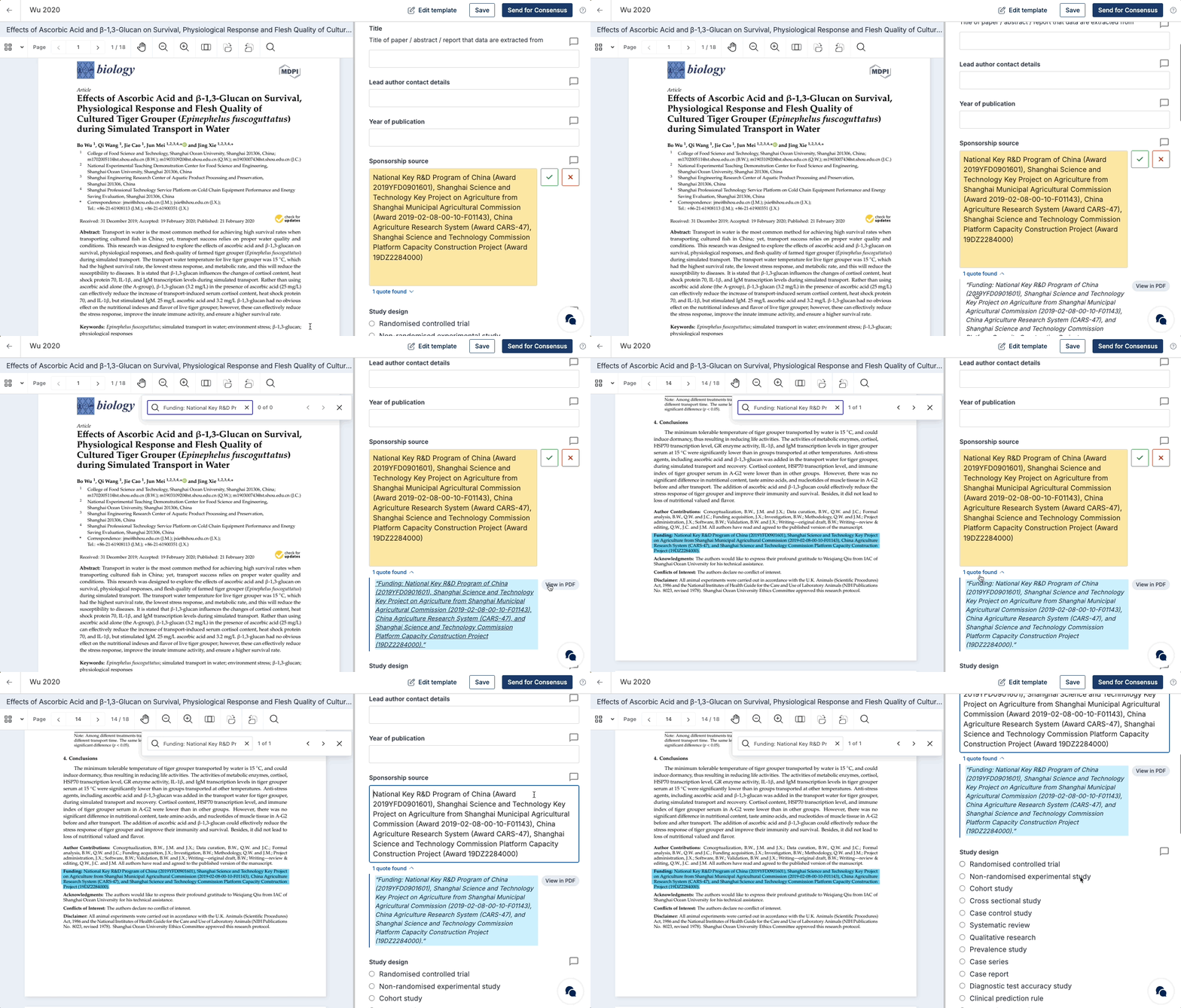
Above: Covidence’s side-by-side data extraction view allows reviewers to extract data while reading the full text.
The result caught them both off guard.
“With Covidence, I did it within one month. Everything was done.”
What could have taken three months was finished in one.
Why rigour mattered more than speed
When Angel reflects on the experience, though, he doesn’t start with speed. He starts with confidence – not confidence based on instinct, but confidence grounded in rigour. Covidence gave him and his colleague a way to review studies independently, compare decisions, and resolve disagreements clearly.
“I think what we did is the right thing, because we were also able to check what each other was doing – he could check what I was doing, and I was also able to check what he was doing.”
That changed both the quality of the work and how defensible it felt.
“You can easily justify and defend your decisions, even as you do the final write-up of the article.”
For Angel, that mattered as much as efficiency. The process wasn’t just faster; it was stronger.
A systematic review tool he recommends without hesitation
The improvement was obvious to his colleague, too.
“When I introduced my colleague to it, he was like, ‘Wow, Angel, how did you learn about this?'”
Working from different locations was no barrier either.
“It’s something that you can manage even when you are in different locations… you can still look at the same thing together, resolve conflicts, and make decisions. It just makes things easier.”
Today, Angel recommends Covidence without hesitation.
“For me, Covidence is the way to go. At the moment, there’s no other tool I would recommend for managing systematic reviews.”
For Angel, the biggest takeaway is simple: Covidence turned what felt like an overwhelming amount of work into a process that was manageable, rigorous, and reliable. In evidence synthesis, that combination matters.
Key takeaways
- A rigorous, defensible review process
- Completed in one month instead of an estimated three
- Independent dual review, with easy conflict resolution
- Collaboration that worked across different locations
- One connected workflow from screening to data extraction
About Dr. Angel Mukuka
Dr. Angel Mukuka is a lecturer in Mathematics Education and Statistics at Dublin City University. His work sits at the intersection of mathematics, statistics, and research methodology – areas where precision, structure, and methodological rigour are essential. This analytical approach shapes how he approaches evidence synthesis, systematic reviews, and data extraction.