Covidence helps students and early-career researchers start their first review with confidence, no experience required.
When you’re new to research, it’s easy to feel overwhelmed by the number of review types out there. Systematic, scoping, narrative, rapid; each serves a different purpose. Understanding which to use can make the difference between a credible study and a confusing one.
Why review types matter
Evidence synthesis means combining insights from multiple studies to answer a research question. It’s how researchers build reliable knowledge, not from one study but from many.
Choosing the right review type is essential because each has its own structure, purpose, and level of rigour. A systematic review, for instance, is designed to answer a tightly focused question with strict methodology and is often used in medical research. A scoping review, by contrast, maps out what research already exists in a field, which is ideal when you’re still defining your question.
Matching your question to your method
A helpful way to decide is to start with your question. Let’s highlight four common review types as an example:
- Systematic review: You want to evaluate effectiveness or compare interventions using clear inclusion criteria.
- Scoping review: You’re exploring what’s already known, identifying gaps, or preparing for a larger study.
- Narrative review: You’re using words and text to summarise and explain your findings, rather than providing a statistical summary.
- Rapid review: You need timely evidence to inform practice or policy decisions.
Each method brings its own strengths. The key is aligning your question, timeframe, and resources with the approach that fits best.
Other review types
Beyond these four common review types, there are several others that students may come across as they advance in their research journey. Umbrella reviews, for example, sit at the top of the evidence hierarchy by bringing together findings from multiple systematic reviews to give a high-level picture of what is already well studied. Integrative reviews combine qualitative and quantitative evidence in a single synthesis, which is useful when you need both numerical outcomes and lived experiences to understand a topic fully. Realist reviews focus on explaining why an intervention works, for whom, and in what circumstances, by examining the underlying mechanisms and context. These methods are especially helpful in education, public health, and social sciences where the effectiveness of a programme depends heavily on local conditions.
You may also encounter review types designed to explore ideas rather than measure outcomes. Qualitative evidence syntheses bring together the themes and experiences reported in qualitative studies. They are commonly used to understand attitudes, barriers, or behaviours. Critical reviews take a more evaluative approach, examining the strengths and weaknesses in existing literature to uncover assumptions or gaps in knowledge. Mapping and bibliometric reviews help researchers visualise how a field is developing by charting study characteristics, trends, and publication patterns. For students starting out, it is not necessary to master every review type. What matters most is understanding that each method answers a different kind of question, and that choosing the right one will make your work clearer, stronger, and more credible.
Building confidence as a new reviewer
Understanding review types helps early-career researchers and students avoid common pitfalls such as using the wrong framework or overlooking existing evidence. It also sets the foundation for transparent, credible, and reproducible research
If you’re guiding others through their first review or starting your own, Covidence can help you every step of the way.
Used by more than 650,000 researchers worldwide, Covidence is the world’s leading platform for managing systematic and other literature reviews. It is the trusted partner and official platform for Cochrane authors.
Covidence takes the complexity out of evidence synthesis by streamlining key steps into one easy-to-use workflow. From importing references and screening studies to resolving conflicts, extracting data, and creating PRISMA flow diagrams, Covidence simplifies the process for both individuals and teams.
Researchers and students use Covidence to stay organized and on track when completing their first review. Librarians and supervisors use it to guide and support students while ensuring methodological quality and consistency. And institutions around the world rely on it to train the next generation of evidence-based researchers.
By removing administrative friction and automating repetitive tasks, Covidence helps you focus on what really matters: asking good questions, analysing results, and building reliable knowledge.
Start your first review with confidence
Your first review can be simple, structured, and stress-free with Covidence. Whether you’re a student completing a thesis or a researcher learning the process for the first time, Covidence guides you through each step clearly and simply.
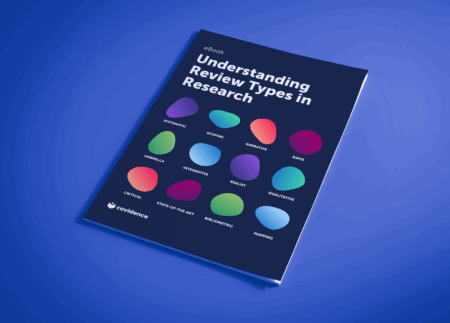
Want to understand more about the different review types? Download the free eBook: Understanding Review Types in Research to learn more about how to choose the right review type for your question.