Outside of your own research discipline and institution, have you ever wondered how other researchers use Covidence – the projects they are working on and their research discipline?
We often have faculty and researchers curious about who is using Covidence outside of medicine, so we thought: why not directly ask users for their feedback?
This blog is an accumulation of the 200+ responses we received from our most recent user survey (Dec 2025). We were positively overwhelmed by how many of you took time out of your day to answer our questions, in particular the detail and examples you shared with us. It’s truly extraordinary to see that Covidence has such a positive impact on the review journey for you all.
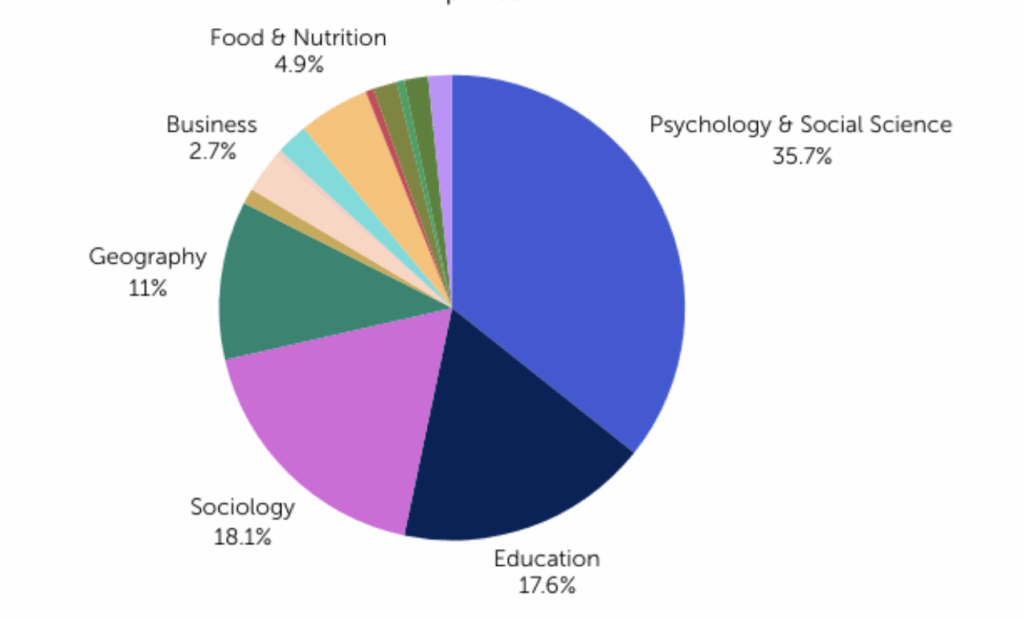
We found that Covidence supports the following research disciplines (excluding medical) most of all:
User Survey Results – % in Varied Research Disciplines
User Survey Results – No. of Users in Varied Research Disciplines
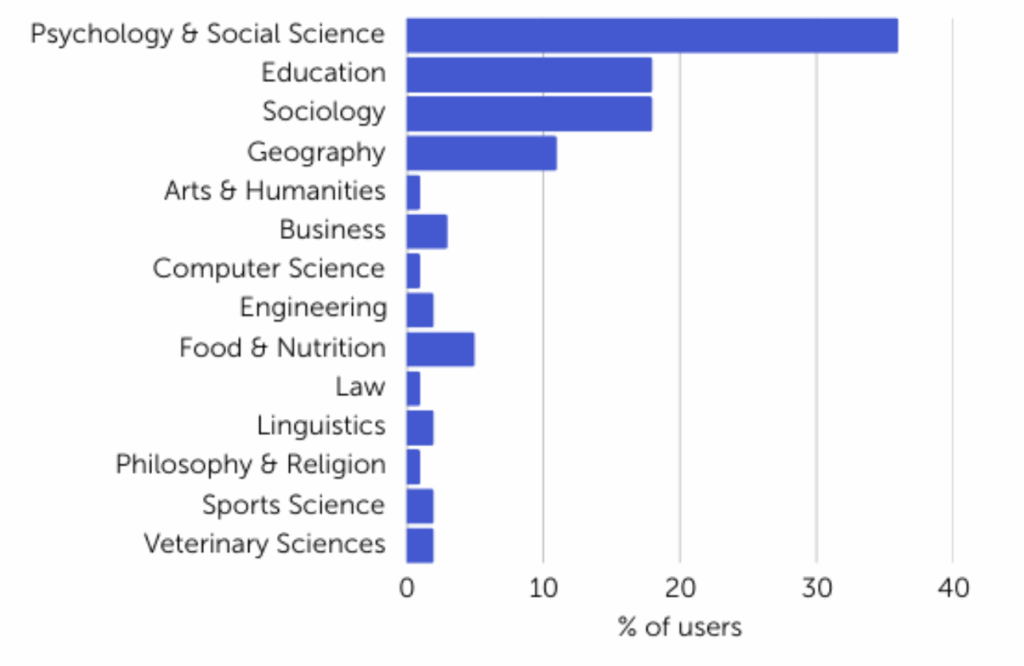
Psychology & Social Science, Sociology and Education are the most popular disciplines for Covidence users, from the 200+ that answered our survey, with Geography and Food & Nutrition falling not far behind. As you can see from the bar graph, many more subjects are thrown in the mix, from Business and Computer Science, to Linguistics and Law. It’s great to see such an array of disciplines finding value from the Covidence tool for their research projects.
This is especially relevant when referencing University World Rankings where rankings are dependent on research quality, volume and reputation. Times Higher Education recently launched World University Rankings by Subject – everything from Business and Economics, to Arts and Humanities, and Engineering is represented. Research really is influential – no matter what department you sit within – and tools like Covidence are needed worldwide to support this.
“Covidence is truly for all disciplines,” said a PhD student from our user survey. “It makes me very pleased with our choice to use Covidence. We can narrow down even the most niche topics with Covidence, which we were pleasantly surprised to see.”
“Covidence supports researchers across all subjects/disciplines in the same great way,” said a Research Fellow from Deakin University, Australia. “By providing an intuitive platform that streamlines the review process, and enables transparency for all researchers to achieve the highest standard in conducting reviews that are relied upon by others.”
Rachel Ayrton, Leverhulme Early Career Researcher from University of Birmingham, England, added: “Covidence provides flexibility – the ability to design your own data extraction template makes it a useful tool across a range of disciplines.”
To find out more information about using Covidence’s data extraction tools, see here.
The Importance of Supporting ALL Research Disciplines
How Covidence has helped support ALL Research disciplines
The Importance of Supporting ALL Research Disciplines
Why does it matter that a tool like Covidence supports all research disciplines?
Simply, all subjects mean a lot to the users doing the research and can have tremendous impacts on guidelines, health, climate change, nutrition and many other factors in both individuals and communities around the world, as well as society itself.
We’ve had users from Arts & Humanities, from Macquarie University, Australia, say that research is important because it “fosters linguistic diversity.” We’ve had others say that “Climate change and biodiversity loss are among the most important and devastating issues of our time” so must be understood and tackled with intention.
Mark Marveggio, PhD Researcher from University of Adelaide, Australia, put it particularly well: “Understanding how the world works, both on the grand scale (e.g. cosmology), the small (e.g. quantum physics), and everything in between, is worth knowing and understanding – because knowing and understanding how the world works gives us a better appreciation for this world we live in. [Research] is ultimately about helping people, and what better purpose is there but to ensure that all people benefit?”
Below are some of the specific reasons Covidence users have chosen their field of research, and why their research is significant to society:
Research Discipline: Business
“We are looking into the intersection of social innovation and family business research,” says a PhD researcher. “We think it is just as important [as more traditional medical fields] because social innovation can be observed practically everywhere in practice, particularly in sustainability initiatives. However, not much has been done to study the phenomenon or the studies are siloed where it is actually very interdisciplinary. Collecting evidence of how and why this is done particularly by family businesses would give us a better understanding of the strategic role family businesses play in our society not just economically but also for social development and environmental sustainability.”
We’ve also had Ahmed Saad, a PhD student from Masaryk University, Czechia, discuss their marketing-focused review project:
“Marketing, at its core, is a window into how people think, feel, and choose. I’ve always been fascinated by human behavior, and studying it through a business lens allows me to turn that curiosity into real impact. For me, it’s about more than products. It’s about helping people make choices that genuinely enhance their lives. That’s what pulls me toward this field every single time.”
Ahmed is exploring nudges for sustainable food choices and how thoughtful design and communication can guide people toward healthier, kinder and more sustainable lifestyles. Meaningful marketing can change how people live, how they feel, and how they contribute to the world. Ahmed exclaims, “I truly believe this research touches human well-being just as deeply as medical research does.”
It’s been noted by users, particularly from Saint Mary’s University, Canada, that ‘business research has been under synthesized’ and that ‘research can be relevant to all occupations – and organizations managing people or processes or technology.’
In the research discipline of business, there is still an underlying desire to make a difference to the people behind the front of an organization – the way they work and the way their business affects the consumer.
Research Discipline: Education
In the Education discipline, it is clear that there is a lack of knowledge holding society back.
A Covidence user from University of Alberta, Canada noted that, “There is very little research on older adult education even though, in 2030, 1 in 6 people in the world will be over 60 years of age.” How can we better respond to this population’s information / educational needs if we don’t increasingly produce significant research in this area? Knowledge acquisition contributes greatly to a person’s quality of life, which, in turn, contributes to a person’s health and wellbeing. This will have a huge effect on our ageing population.
Other Covidence users take a younger-focus to Education:
Danielle Perfect, Research Associate and PhD Student from University of South Australia, shared that “I chose this subject because of what I kept seeing in my work with early childhood educators in the Pacific region: they care deeply and work incredibly hard, but the support they receive to grow their practice is often ad hoc, inconsistent, or not informed by evidence.”
With a PhD focused on teacher professional development, Danielle’s goal is to answer the question: what actually helps early childhood educators to change and improve their practice in lasting ways? She truly believes that ‘high-quality professional development is one of the most powerful levers we have for improving teachers’ knowledge and skills, which in turn can influence children’s learning, safety and wellbeing at scale. Rather than relying on one-off workshops or “tick-box” training, I want to help build approaches that are practical, sustainable, and respectful of educators’ time and expertise. If we can strengthen the systems, we can strengthen outcomes for the children and families they serve.”
Danielle reiterates that “Medical research often treats problems once they appear. Education research, especially in the early years, helps to stop some of those problems from emerging in the first place.”
It’s really inspiring to see so many researchers not only undergo reviews in their field to pre-empt future problems and create robust systems but also because of dreams and experiences they’ve had years ago.
A Research Assistant and PhD Student from Vanderbilt University, United States opened up: “I worked with a child with Down Syndrome when I was in 10th grade and when I went to college I knew then I wanted to become a special educator to help individualize instruction for every single kid—they deserve it.”
She added that “All people go through the education system, similar to the medical field. It’s a human field that affects everyone and it deserves justice and cutting edge research because our kids deserve the best.”
And it’s true – if we can support education knowledge through cutting-edge research projects, we all play a significant part in building a better education system which helps society at large.
Research Discipline: Engineering
With over 25 years of experience in the engineering field, specifically mining, Covidence user Eugene Opperman has recognized the impact of human behaviour on maintenance optimization. She noted that “my systematic literature review allowed me to express my views on the subject and provide recommendations for future explorative research.”
Eugene has expressed that the role of human factors in maintenance environment remains “a critical, yet underexplored dimension as operators and maintainers of machines and equipment strive to improve efficiency and optimization in the workplace. To achieve these objectives, cognitive work analysis, communication methods, fatigue and stress management, lack of training, resistance to change and ergonomics are only but a few factors to consider when critically reviewing the human factors in a mining and manufacturing context.”
With this in mind, as well as the introduction of advanced technologies over the last two decades, addressing how human behaviour interfaces with maintenance strategies is key.
A PhD researcher from University of Guelph, Canada added that “the health of the environment is the health of us all. If our environment continues to degrade at the rate it currently is, there will be nothing left for us to research in any field including medical. The urgency of the topic is self-evident and I think it is time that we take a fresh approach to tackling the issues we are facing.”
Research Discipline: Food & Nutrition
What we consume in our day-to-day highly impacts our health and wellbeing, and Laura Mueller, PhD Candidate from University of Buffalo, United States, put it best: “in short, we are what we eat!”
Laura shared that “Food insecurity is an ongoing, worldwide issue and impacts individuals in many ways—from cognitive performance, obesity, and sleep, to mental and social well-being. By synthesizing the existing literature, we can develop better policies and interventions to address this problem, especially among populations at high risk for adverse health outcomes, such as adolescents and young adults.”
It is not only the food itself that impacts us, but also food packaging. Globally, households are wasting more than 631 million tonnes of food each year. Brian Llagas, PhD Candidate from RMIT University, Australia, mentioned that, socially, we want to help households save money and support community food rescue. Environmentally, we want to save huge amounts of food packaging from landfill every year, which is currently resulting to high GHG emissions and high pressure on natural resources. Spreading knowledge of these issues through research projects help us to improve the world we live in.
Anne Wilcock, Professor at University of Guelph, Canada, made an excellent comment that nutrition is tied very closely to the medical field:
“Food safety is an essential discipline, and one that I wish were recognized as such. Unsafe food can lead to foodborne outbreaks which feed into the medical system. Safe food, on the other hand, minimizes illness, saves lives and makes economic sense. Hence, food safety is closely allied to the medical system.”
Research Discipline: Linguistics
As Gabriel Bäck, PhD Student from Linnaeus University, Sweden, has shared with us: “Language and meaning-making is necessarily involved in everything we do.”
It’s true – language shapes our everyday life in different spaces and contexts, and the research behind how we use it helps us to better understand intentions, cultures and how we communicate most effectively with one another.
A Covidence user from our survey, who prefers to remain anonymous, told us that their research field of “nexus analysis is an increasingly influential theoretical and methodological framework within the field of applied linguistics, particularly educational linguistics.” Exploring the rationale for why people take particular actions, it gives insight into, for example, “why teachers take certain pedagogical decisions or into the influence of language ideologies on language policy.”
They also shared that “it was important to [their research] to clarify how certain concepts were operationalised across studies, and Covidence made that possible in a systematic way. While our work does not address physical health in the way medical research does, it is equally important in that it examines how communicative practices shape learning, inclusion, identity, and access to opportunities.”
Ultimately, research projects like these help educators to better understand the sociocultural forces that affect learners’ experiences, and help us to address the best way to engage with one another.
Users therefore need a research tool to make their vision and aspirations come to life…
And that’s why Covidence was originally born! Designed by researchers for researchers. We understand that collating studies and bringing a research idea to life takes work (a lot of it!), and having a workflow tool to guide you through it and save you time, increase efficiency and boost accuracy truly makes a difference to the experience.
How Covidence can help support your research discipline
From the user survey, we appreciated the insight you all gave us into how specifically Covidence has helped you achieve your research goals. And we couldn’t help but share some of our favourite quotes below…
Research Discipline: Psychology
“What Covidence really offered was a place where I could think clearly. I used the note section constantly, almost like a running commentary to myself: “this paper groups all life periods together,” “this one separates early and late life memories,” “check how they define remote events.” Covidence let me create a trail of decisions that I could follow later on without losing my earlier thoughts.
My work brings together studies from psychology, neuroscience and different strands of memory research. There is no single template I can rely on, so I often need to form my own categories as I go. Covidence supports that kind of work by giving me space to shape the structure myself. It does not force fixed labels or predefined pathways. When one study refers to “distant personal events” and another uses “remote life memories,” I can organise them in a way that makes sense for my review rather than adjusting my criteria to fit the platform.”
Mehmet Akif Elen, PhD Student, Yeditepe University, Turkey
“Covidence supports researchers in psychology surprisingly well because it takes some of the heaviest tasks in psychological and neuroscience reviews and makes them easier to manage. These disciplines often deal with large, diverse bodies of literature, mixed study designs, and detailed methodological reporting. Covidence helps handle that complexity by offering fast screening tools, structured full-text workflows, and clean data-extraction setups that reduce errors and keep everything consistent. It also makes it simple to manage inter-rater agreement, which is essential when reviewing behavioural or clinical studies where judgement calls can vary. What this really means is that Covidence doesn’t just store papers;it creates a workflow that matches the way evidence is evaluated in psychology and neuroscience, letting researchers spend their energy on interpretation instead of admin.”
Kanwal Shahbaz, HDR Candidate, RMIT, Australia
“Covidence supports research in occupational and health psychology very well because it streamlines key stages of the systematic‐review process, which is essential in evidence-based disciplines. In my field, studies often involve diverse populations, varied psychometric instruments, and multiple overlapping outcomes such as stress, anxiety, or fatigue. Covidence’s structured screening and data-extraction tools help manage this complexity by allowing clear decision-making, transparent documentation, and consistent reviewer agreement.
The platform’s PRISMA-aligned workflow is especially valuable for psychological research, where methodological rigor and traceability are critical. Overall, Covidence makes it easier to handle large volumes of studies and maintain consistency across reviewers.”
Antonia Charalambous, Student Researcher
Research Discipline: Sports Science
“Covidence supports researchers in my field—public health and physical activity research—very effectively. Reviews in this discipline often involve large datasets and multi-stage screening, and Covidence provides a structured workflow that helps ensure transparency and accuracy. Its clear interface, conflict-resolution features, and support for uploading full-text PDFs make it particularly useful for reviews examining behavioral interventions, which require careful and standardized assessment.”
Anonymous at University of Newcastle, Australia
“Covidence is an excellent tool to increase transparency and collaboration with co-authors. Reviews are sparse in dance and Covidence enhances the rigor with which reviews can be done. It’s all about showing other dance researchers that Covidence can make their work easier and more meaningful.”
Michelle Dwarika
“More and more drowning prevention researchers are using Covidence as it supports collaborative work across different timezones and areas of the world. In this area of research, teams are usually very multidisciplinary and spread across different regions of the world. It is a user friendly tool that works great on different types of devices.”
Violence and Injury Prevention Consultant, World Health Organisation (WHO)
Research Discipline: Geography
Covidence is highly supportive of researchers working at the intersection of climate change and health, particularly because this field often involves synthesizing evidence from diverse disciplines and large, rapidly expanding bodies of literature. By simplifying technical aspects of the review process, Covidence allows researchers to focus more on interpreting findings and identifying knowledge gaps, facilitating an essential step in advancing climate and health research.”
Brenda Zai, PhD Candidate, University of Guelph, Canada
“For my scoping review, where I was tracking exposures (e.g., floods, droughts, heatwaves) and mental‑health outcomes across multiple Southeast Asian countries, Covidence’s customisable data‑extraction templates are especially valuable, they let me collect study‑level variables systematically (e.g., exposure type, population demographics, outcome measures) and enabled easier mapping of my evidence base. In addition, because the tool is designed for transparency, it supports better reporting (e.g. PRISMA flow diagrams) and provides audit trails which increase the rigour of my work;this is critical for high‐quality scoping reviews.
In essence, Covidence enhances both efficiency and methodological robustness, which makes it an excellent fit for my discipline’s need to synthesise multi‐dimensional evidence and advance knowledge in the climate‑health domain.”
Research Fellow at Monash University, Australia
“Covidence supports researchers in my field extremely well because environmental and restoration sciences increasingly rely on transparent, systematic evidence reviews. In mangrove restoration, studies are scattered across disciplines (from ecology to social science), so having a platform that helps centralises screening, tracks decisions, and reduces duplication is invaluable.”
Alexandra Rodriguez
Research Discipline: Social Science
“As a social worker, [Covidence] allows me to bring together research related to mental health AND airline pilots in one location. A very niche topic that may not fit elsewhere.”
Melissa Campos, Therapist at Koselig Counselling, Canada
Covidence supports researchers in social work very well, as the system is efficient and well suited for conducting literature reviews.”
Katrina Nyman, Researcher
“Covidence is really helpful for social work research because it takes a lot of the overwhelm out of bringing together evidence from different disciplines. Suicide bereavement is a multidisciplinary topic, and Covidence provides a clear, organised system for navigating that complexity. The structured screening process helps keep things consistent and rigorous, which is important in social work where study quality can vary significantly, and it also supports the person-centred approach that underpins the discipline. This is especially valuable in a scoping review, where available evidence is often heterogeneous and relatively thin, and the purpose is to map what exists rather than analyse depth.”
Stacey Donohoe, Social Work Lecturer, University of Wollongong, Australia
“I think Covidence does an amazing job at supporting autism researchers focused on aging. The autism research field is vast and dense, but individually picking through millions of autism articles for a slight mention of adulthood, aging, or non-pediatric populations is impossible. The worse part is that there will be mentions of adulthood and aging in the implications sections of empirical papers that have no participants that fit that criteria. There is genuinely no other tool out there where I can simply upload the metadata of 6,000+ autism articles and find the ~50 that actually engage with autistic adults instead of simply thinking about the hypothetical adulthood of pediatric autistic participants.”
Project Assistant, University of Wisconsin-Madison, United States
Research Discipline: Education
“Covidence is an excellent tool for health education research—as well as for many other fields. It simply gets the job done.”
Penelope Parra
“My field (educational technology and instructional design) is a highly pragmatic and ever changing field. The amount of research is vastly increasing everyday. Therefore, (systematic) reviews are an important part of our scholarly work to know the best practices of learning, teaching, and instruction. Also, most of the research we do is collaborative work rather than a solo author/ researcher modality like in some other social sciences. In these regards, Covidence provides a collaboration-friendly and efficient tool.”
Graduate Research Assistant, Florida State University, United States
“Covidence is very plug and play. The ability to customize at various steps, for instance entering our own in/exclusion criteria, is useful for researchers working in a specific domain like education, from a cross-disciplinary humanities and social sciences angle.”
Andreas Lieberoth, Associate Professor, Head of Digital Generations Educational Research Unit, Danish School of Education, Aarhus University, Denmark
Research Discipline: Sociology
“Covidence supports Indigenous business and Indigenous governance research very well because it accommodates complex, interdisciplinary reviews that draw from academic, grey, and policy sources. Covidence helps by providing a structured environment where mixed evidence types can be screened and extracted consistently. It allowed me to import large sets of citations efficiently, screen over 1,000 records with paired reviewers, and track inclusion decisions systematically. The ability to highlight text and annotate directly in the extraction form helped me stay organized across multiple frameworks, particularly when analyzing Indigenous governance literature alongside Western financial governance research. Covidence also reduced administrative workload by automatically removing duplicates.”
Tiffany Sack, Senior Manager Strategic Opportunities, First Nations Financial Management Board
“Covidence has supported my work by: Providing a clear structure for screening large volumes of interdisciplinary literature, especially work connected to Indigenous knowledge, culture, and symbolism. Allowing me to track how Western sources contrast with — or create space for — Indigenous forms of understanding. Offering a workflow that helps navigate intersections between oral knowledge, land-based teachings, and academic theory.
It has been useful precisely because it allows me to work at the interface of Indigenous worldview and academic expectations.”
Deyowidront Morrow
What’s Next?
First of all, we hope that you found this blog post on niche research disciplines useful for understanding the myriad of ways Covidence can be used for research and reviews. Hopefully you found some parts that resonated with your own research, or ideas for how Covidence could be used effectively across your institution.
Of course, you may have some questions too.
If you already have a Covidence account and would like help with the platform, reach out to us at support@covidence.org
If you would like to explore a Covidence license, either for your department or organization-wide, get in touch with us via this form.
An enormous thank you to everyone who participated in the user survey to make this blog happen! Your thoughts and experiences with Covidence are truly appreciated, and we hope you continue to enjoy our research tool and support for years to come.